Woman impersonating Jane Russell
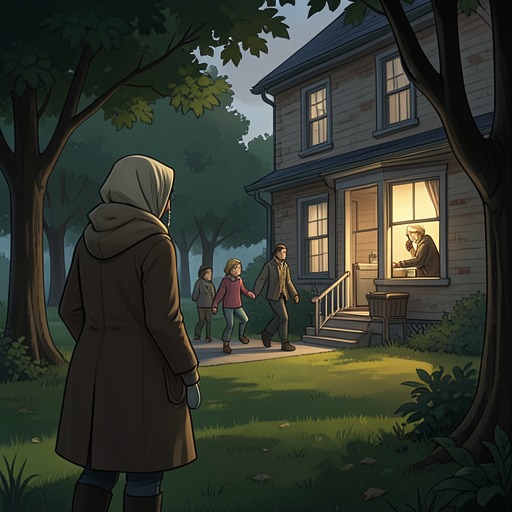
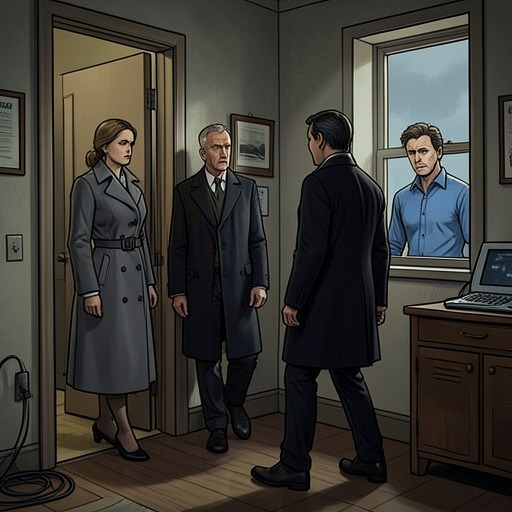
The Woman in the WindowThe Woman impersonating Jane Russell is the figure whose presence turns Anna Fox’s confidence in what she has seen into an open dispute over identity and credibility. Alistair Russell presents her as his wife, and Detective Val Norelli identifies her as Jane Russell, but Anna rejects that name: she says she has never seen this woman before and insists that the Jane she met is someone else. The woman’s own responses keep the contradiction unresolved rather than explaining it.## Introduction and Identification The woman enters Anna Fox’s home with Alistair Russell, after Ethan Russell has arrived ahead of them. Alistair shuts the door and introduces the newcomer as his wife. The sequence gives the introduction the weight of a social fact: she is not merely an unknown visitor, but a woman presented by Alistair as part of the Russell household. Anna’s immediate response, however, is inward and absolute. Looking at both Alistair and the woman, she registers that she has never seen this person in her life.
Anna’s account gives the woman a distinct, carefully observed appearance. She is tall but fine-boned, with sleek dark hair framing a sculpted face; her brows are slender and arched above gray-green eyes. She regards Anna coolly, crosses the kitchen, and extends a hand. The offered greeting would ordinarily establish a meeting between strangers, but Anna’s perception makes the gesture more unsettling: the woman is being introduced as someone familiar to the other people present, while Anna experiences her as a stranger.
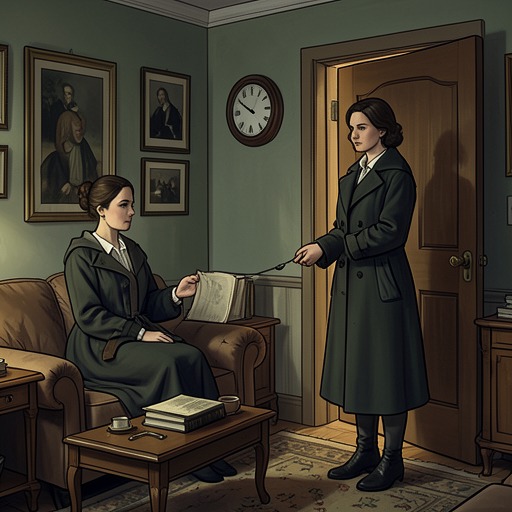
The woman says, “I don’t believe we’ve met,” a courteous formulation that seems to acknowledge distance between them. Anna does not accept that exchange as a simple first meeting. When Detective Val Norelli names the woman as Jane Russell, Anna answers, “No, you’re not.” She then repeats to the detectives that the woman is not Jane. The woman withdraws her hand, leaving the introduction without the ordinary resolution of a handshake or mutual recognition.## Conflicting Claims and the Café Encounter The later café scene brings the identity conflict into direct conversation. A barista calls the woman Jane while trying to get her attention about a latte. She accepts the cup in its snug cardboard jacket and tells Anna, “You know who I am.” The claim presumes recognition, but Anna rejects its premise. She says she knows Jane, has met her, and has seen her in her house. The woman counters that the house is hers and that Anna did not see anyone there.
Their exchange gives each woman a different account of the same supposed encounter. Anna treats her earlier experience as firsthand evidence: she distinguishes the woman in the café from the Jane she remembers meeting in a house. The woman does not offer a history or explain why Anna’s account is wrong; instead, she denies the underlying sighting. That denial leaves the central question unsettled. The scene does not supply an independent explanation for the discrepancy, so the reader encounters the woman through competing assertions rather than a definitive account of who she is.
The café’s everyday details make the confrontation public without making it clarifying. The barista’s repeated call and the latte briefly situate the woman in an ordinary transaction, while Anna presses for an answer about Jane’s whereabouts. The woman’s response is not recognition or reassurance. She says she does not know who or what Anna is talking about and announces that she is calling the police.## Conduct and Conflict The woman’s conduct changes with the setting. At Anna’s home she approaches, extends her hand, and then withdraws it after Anna rejects her identity. In the café she accepts her drink, speaks directly to Anna, and ultimately pushes past her, knocking Anna’s shoulder with her own. Anna watches her leave in the mirror as she maneuvers between the tables. The physical contact gives the exchange a consequence beyond verbal disagreement, but it does not settle which account is true.
Her threat to call the police reverses the roles Anna might expect from her demand for help. Anna whispers, “Just tell me where she is,” asking the woman to account for Jane; the woman instead frames Anna’s pursuit as something requiring police attention. The departure ends the confrontation without an answer. The doorbell sounds as the woman opens the door and again when it slams behind her. Anna remains in the quiet room, looking down at her umbrella, and concludes that she has learned nothing.
The woman is therefore defined less by disclosed biography than by the collision between how others identify her and how Anna perceives her. Alistair calls her his wife, Detective Val Norelli calls her Jane Russell, and she asserts that Anna knows who she is. Anna refuses all three points of recognition as proof that this is the Jane she encountered. The woman’s denial and departure preserve the gap rather than closing it.## Narrative Role Because the disputed identity is presented through Anna’s first-person perspective, the woman’s appearance and conduct are available to the reader through Anna’s seeing and hearing, while her own account remains limited to brief statements. This restricted access makes the woman a focal point for the novel’s uncertainty about perception and credibility: Anna’s insistence may be forceful, but the scenes provide no neutral witness who resolves the contradiction between her memory and the woman’s denial.
The woman also makes recognition itself a source of conflict. A hand extended in greeting, a name spoken by a detective, and a confident claim that Anna knows her would normally stabilize a person’s identity. Here, each is met by refusal or counterclaim. The café encounter repeats the home’s failed introduction in a sharper form: Anna again identifies Jane as someone other than the woman before her, and again receives no information that reconciles the two. The woman’s significance lies in that unresolved division. She leaves Anna with the same question that governed their exchange—where Jane is—and with no answer that can be verified.